
India's story is etched in stone, marble, and rock, a sprawling epic told through millennia of human endeavour. Each fort, temple, and tomb is more than just a tourist attraction; they are chapters in a living history book, chronicling the rise and fall of empires, celebrating unparalleled artistry, and preserving profound spiritual traditions. This guide moves beyond the typical travelogue to explore the most important historical monuments in India, offering a deeper understanding of their significance and providing practical, actionable tips for an unforgettable visit.
We've curated this roundup to serve as a definitive resource, whether you're planning a grand cultural tour or seeking to add a touch of history to your coastal getaway. For families enjoying a beach vacation in Goa or Malvan, or couples on a romantic retreat in Alibag, integrating a visit to a nearby monument can enrich your experience immensely. This article will equip you with essential details, from navigating crowds at the Taj Mahal to understanding the intricate carvings of the Ellora Caves. Prepare to journey through the architectural heart of a nation, discovering not just what these monuments are, but why they continue to captivate the world and how to experience them meaningfully with MGA Tour Packages.
1. Taj Mahal
An eternal monument to love, the Taj Mahal in Agra is arguably the most recognised of all the important historical monuments in India. Commissioned in 1632 by the Mughal emperor Shah Jahan, this ivory-white marble mausoleum was built for his favourite wife, Mumtaz Mahal. Its perfect symmetry, intricate carvings, and the seamless fusion of Persian, Islamic, and Indian architectural elements make it a global masterpiece.

The monument's influence is profound, serving as a model for architectural projects worldwide and a key subject in studies on historical preservation. As a UNESCO World Heritage Site, it stands as a testament to the artistic and engineering prowess of the Mughal era.
### Visiting the Taj Mahal
To make the most of your visit, consider these practical tips:
- Best Time to Visit: Arrive at sunrise (around 6:00 AM) to witness the marble glow with soft, ethereal light and to avoid the large midday crowds. Sunset also offers a spectacular, albeit more crowded, view.
- Guided Tours: Hiring a government-approved guide at the ticket counter can significantly enrich your experience with detailed stories and historical context.
- Time Allocation: Plan for at least 3-4 hours to explore the main mausoleum, the surrounding gardens (Charbagh), the mosque, and the guesthouse.
- Photography Rules: While photography is permitted across the complex, it is strictly prohibited inside the main mausoleum to protect the delicate interior.
A trip to the Taj Mahal offers a profound connection to India's rich history, much like the cultural experiences found on coastal getaways. For those planning a journey that combines history with relaxation, exploring our tour packages for your next holiday can provide a well-rounded itinerary.
2. Qutub Minar
A towering symbol of victory and the beginning of Muslim rule in India, the Qutub Minar in Delhi is a magnificent example of early Indo-Islamic architecture. The construction of this 72.5-metre-high minaret began in 1192 under Qutub-ud-din Aibak and was completed by his successors. Made of red sandstone and marble, its intricate carvings and verses from the Quran make it one of the most important historical monuments in India.
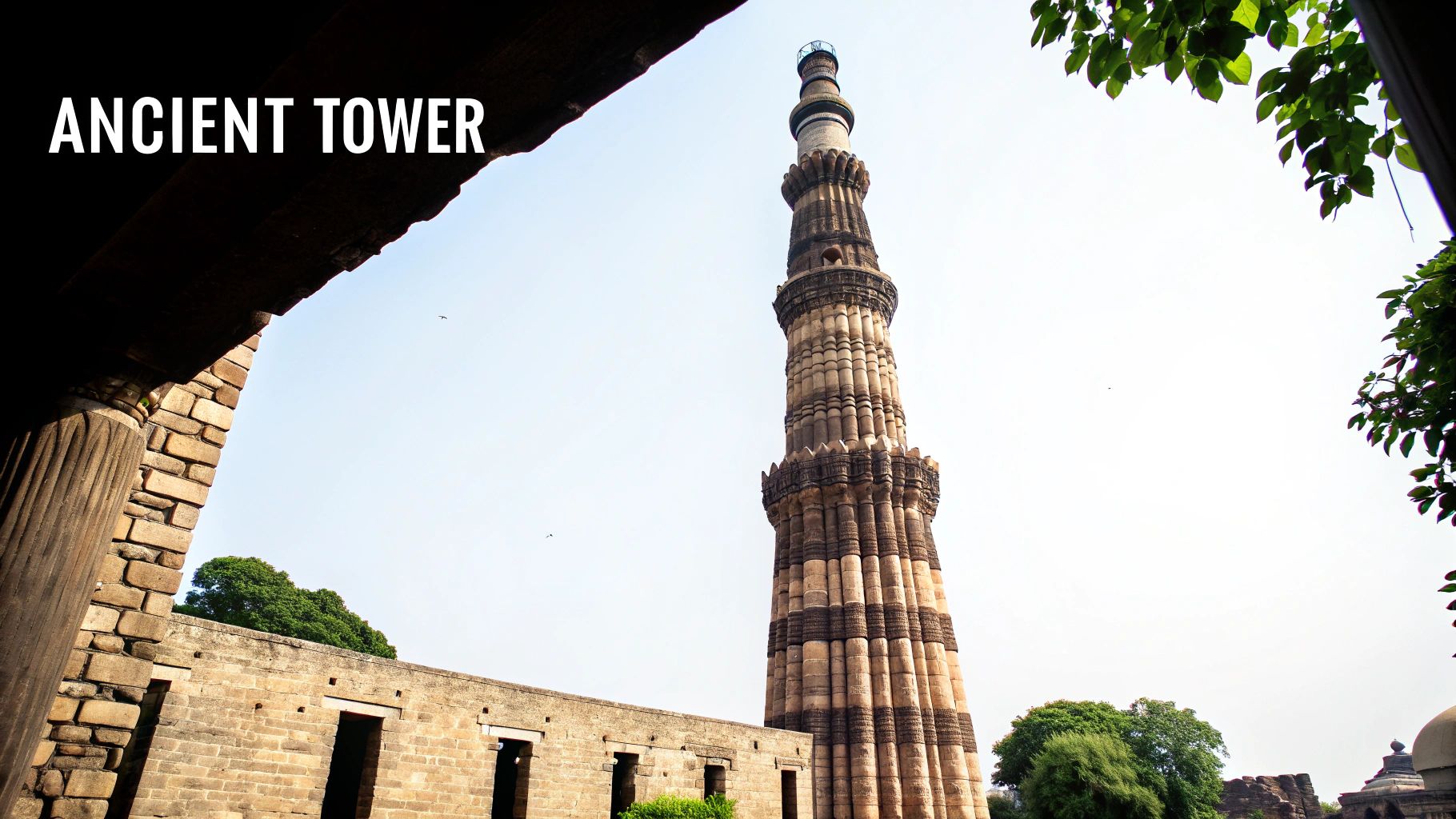
This UNESCO World Heritage Site has inspired minaret designs across the mediaeval Islamic world and serves as a crucial model for understanding the fusion of architectural styles. The surrounding Qutub complex, which includes the Quwwat-ul-Islam Mosque, is a testament to the rich history and artistic achievements of the Delhi Sultanate.
### Visiting the Qutub Minar
To ensure a memorable visit, consider these practical tips:
- Best Time to Visit: The cooler months from November to February offer the most pleasant weather for exploring the expansive complex. An early morning or late afternoon visit helps avoid the intense sun.
- Audio Guides: Rent an audio guide at the entrance to get a detailed narrative of the site's history, architecture, and the stories behind the various structures within the complex.
- Time Allocation: Dedicate at least 2-3 hours to fully explore the Qutub Minar, the famous Iron Pillar, the Alai Darwaza, and the ruins of the Quwwat-ul-Islam Mosque.
- Photography Rules: Photography is permitted throughout the site, but the use of drones is strictly prohibited.
Exploring Delhi's historical treasures can be beautifully combined with a relaxing coastal holiday in Goa. For travellers looking to create a diverse itinerary that blends historical exploration with serene beach getaways, consider our customised travel plans. Discover more about tour packages for your next holiday to plan a perfect trip.
3. Ajanta Caves
A breathtaking testament to ancient artistic devotion, the Ajanta Caves in Maharashtra are among the most important historical monuments in India. This complex of 30 rock-cut Buddhist caves, carved between the 2nd century BCE and the 5th century CE, showcases some of the finest surviving examples of ancient Indian art. The magnificent paintings and sculptures within depict the Jataka tales, illustrating the Buddha's previous lives, and offer an unparalleled window into the culture of that era.
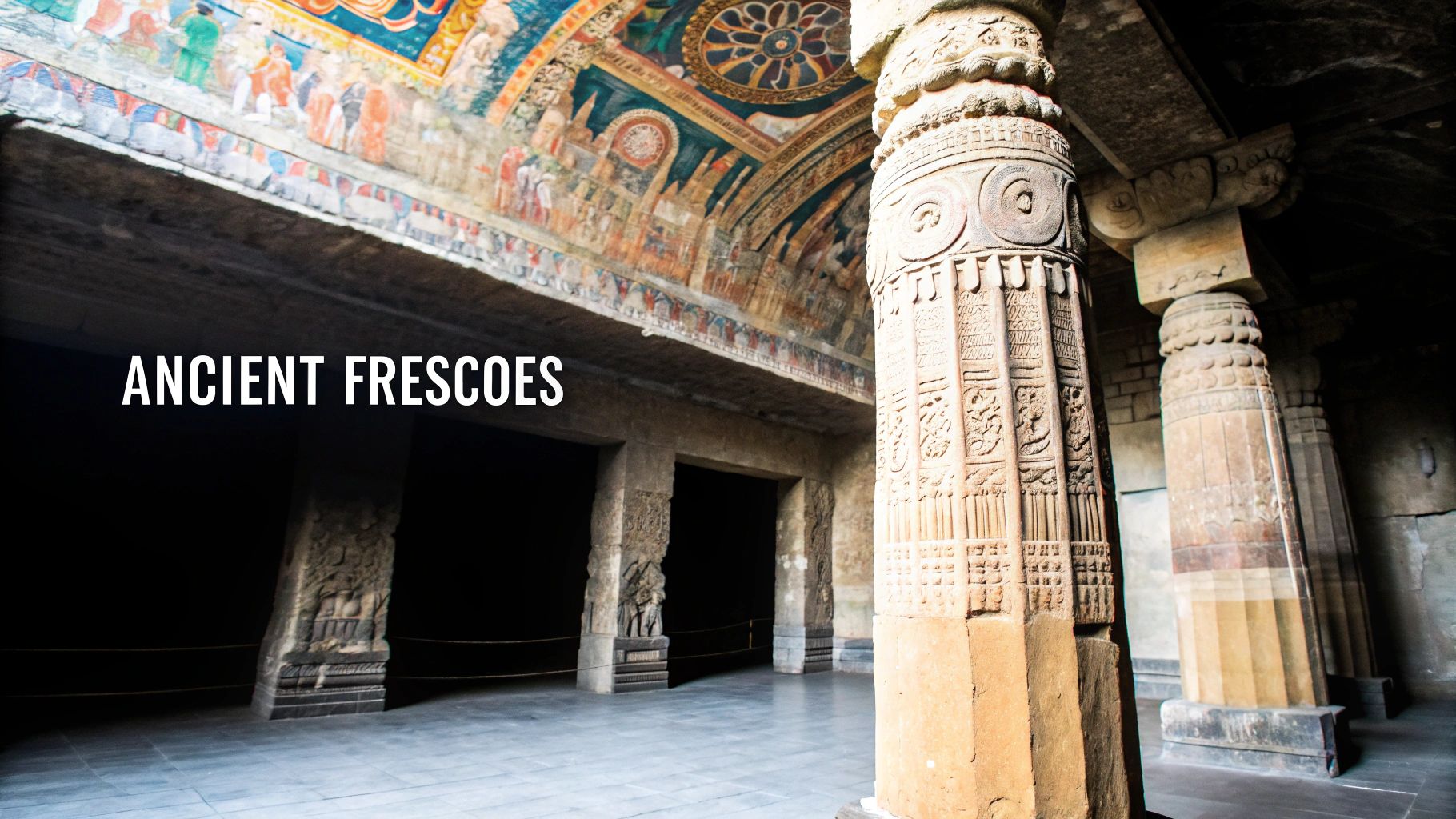
As a UNESCO World Heritage Site, the caves represent the apex of Buddhist cave artistry in India. Their influence is immense, providing a basis for understanding the evolution of Buddhist art across Asia and serving as a model for rock-cut architecture preservation techniques.
### Visiting the Ajanta Caves
To fully appreciate the artistic splendour of the Ajanta Caves, consider these practical tips:
- Best Time to Visit: The dry season, from October to April, offers the most pleasant weather for exploring the expansive site. The lush post-monsoon greenery makes the surroundings particularly beautiful.
- Expert Guidance: Hiring a knowledgeable local guide is highly recommended to interpret the intricate frescoes and sculptures, which are rich with symbolism and narrative detail.
- Time Allocation: Dedicate a full day (at least 5-6 hours) to do justice to the site. The caves are spread out and require significant walking to explore comprehensively.
- Photography Rules: To preserve the ancient pigments, flash photography and tripods are strictly prohibited inside the caves, especially near the painted walls.
Combining a trip to these ancient caves with a relaxing coastal holiday is an excellent way to experience the diversity of Western India. MGA Tour Packages can help you discover insider secrets for planning your journey to nearby Goa or Malvan. Find out about tour packages in Goa that can create a perfect itinerary.
4. Ellora Caves
A stunning example of Indian rock-cut architecture, the Ellora Caves in Maharashtra represent a unique synthesis of religious harmony. This UNESCO World Heritage Site features 34 monasteries and temples, excavated between the 6th and 10th centuries CE, that stand side-by-side. The complex showcases the artistic traditions of three major religions: Buddhism, Hinduism, and Jainism, making it a powerful symbol of the religious tolerance prevalent in medieval India.
The site’s masterpiece, the Kailasanatha Temple (Cave 16), is the world's largest single monolithic rock excavation. The Ellora Caves are among the most important historical monuments in India because they demonstrate an unparalleled continuity in religious art and architecture, offering profound insights into the cultural fabric of the era.
### Visiting the Ellora Caves
To fully appreciate the scale and detail of this historical marvel, consider these tips:
- Best Time to Visit: The monsoon and winter months (June to March) offer pleasant weather for exploring the vast, open-air complex. Aim for early morning to avoid the heat and crowds.
- Starting Point: Begin your tour at Cave 16 (the Kailasanatha Temple), as it is the most impressive and centrally located structure. From there, you can explore the other Hindu, Buddhist, and Jain caves.
- Time Allocation: Dedicate at least 6-8 hours for a comprehensive visit. The site is extensive, and each group of caves requires significant time to explore properly.
- Footwear and Attire: Wear comfortable and sturdy walking shoes, as the terrain is uneven and requires extensive walking. Light, breathable clothing is recommended.
A journey to the Ellora Caves offers a deep dive into India’s ancient artistic and spiritual heritage. For those looking to blend historical exploration with coastal relaxation in Goa, Malvan, or Alibag, MGA Tour Packages offers excellent travel opportunities. You can find comprehensive tour packages for your next holiday that combine such diverse experiences.
5. Khajuraho Temples
A stunning testament to mediaeval Indian art and architecture, the Khajuraho Group of Monuments in Madhya Pradesh is a unique complex of Hindu and Jain temples. Built by the Chandela dynasty between the 10th and 11th centuries, these temples are renowned for their Nagara-style architectural symbolism and their intricate, often erotic, sculptures that adorn the temple walls. Originally a complex of 85 temples, 25 have survived, each a masterpiece of design.
The monument's influence lies in its unparalleled depiction of philosophical and social life through sculpture, providing insight into the tantric traditions of the era. As a UNESCO World Heritage Site, Khajuraho stands out as one of the most important historical monuments in India for its artistic brilliance and architectural innovation.
### Visiting the Khajuraho Temples
To make the most of your visit, consider these practical tips:
- Best Time to Visit: Early morning light is ideal for photography, beautifully highlighting the intricate details of the sculptures. The evening Light and Sound show also offers a captivating historical narrative.
- Guided Tours: An expert guide is highly recommended to understand the complex symbolism and philosophical context behind the famous sculptures.
- Time Allocation: Plan for a full day to properly explore all three groups of temples: the Western, Eastern, and Southern clusters, as each offers a unique perspective.
- Photography Rules: Photography is generally allowed, but be respectful and observe any restrictions, particularly inside the sanctums of the temples.
A journey to Khajuraho offers a deep dive into India's artistic heritage, a perfect complement to a relaxing holiday in Goa. For those looking to blend historical exploration with leisure, MGA Tour Packages can help combine such trips into a broader travel plan that is highly rewarding. Learn more about tour packages for your next holiday.
6. Red Fort (Lal Qila)
A powerful symbol of Mughal grandeur and Indian sovereignty, the Red Fort, or Lal Qila, stands majestically in the heart of Delhi. Commissioned by Emperor Shah Jahan and completed in 1648, this massive fortress of red sandstone served as the main residence of Mughal emperors for nearly 200 years. Its imposing walls enclose a complex of palaces, entertainment halls, and ornate mosques, showcasing the zenith of Mughal architectural ingenuity.
Recognised as a UNESCO World Heritage Site, the Red Fort is one of the most important historical monuments in India, representing a crucial period of the nation's history. It holds deep cultural significance, as it is from its ramparts that the Prime Minister of India hoists the national flag and addresses the nation on Independence Day (15th August).
### Visiting the Red Fort
To ensure a memorable and comfortable visit, consider these practical tips:
- Best Time to Visit: Arrive early in the morning, shortly after it opens, to avoid the intense Delhi heat and the large crowds that gather later in the day.
- Guided Tours: Hiring a knowledgeable local guide can bring the stories of the emperors and the fort's intricate history to life, adding immense value to your exploration.
- Time Allocation: Dedicate at least 2-3 hours to walk through the expansive complex, including the Diwan-i-Aam (Hall of Public Audience) and Diwan-i-Khas (Hall of Private Audience).
- Comfort is Key: Wear comfortable walking shoes as the grounds are extensive. Also, carry sun protection like a hat and sunscreen, especially during the hotter months.
A visit to the Red Fort immerses you in the heart of India's Mughal past and its journey to independence. This historical immersion can be beautifully complemented by a relaxing coastal retreat in Goa. For those looking to combine historical discovery with leisure, exploring MGA Tour Packages' diverse travel options can create the perfect holiday. Discover more about our tour packages for your next holiday.
7. Hampi (Group of Monuments)
The Group of Monuments at Hampi transports visitors back to the glory of the Vijayanagara Empire. Located in Karnataka, this sprawling archaeological site features the ruins of a magnificent 14th-century city that was once the prosperous capital of a powerful Hindu kingdom. Spread across a stunning, boulder-strewn landscape, Hampi contains over 1,600 surviving remains, including majestic temples, royal palaces, aquatic structures, and ancient market streets, making it one of the most captivating historical monuments in India.
This UNESCO World Heritage Site is a crucial model for understanding ancient Hindu urban planning and the evolution of Dravidian architecture. Its well-preserved structures serve as a powerful testament to the artistic and cultural zenith of the Vijayanagara rulers before the city's fall in the 16th century.
### Visiting Hampi
To fully appreciate the vastness and intricacy of Hampi, consider these tips:
- Best Time to Visit: The cooler, pleasant months from October to February are ideal for exploring the exposed terrain. Arrive at sunrise to see the ruins bathed in a dramatic golden light.
- Time Allocation: Plan for a minimum of 2-3 days. The site is immense, and rushing through it means missing out on hidden gems and the overall atmosphere.
- Getting Around: Renting a bicycle or a scooter is the most efficient way to navigate between the various clusters of monuments. Auto-rickshaws are also available for guided day tours.
- Local Guides: Hiring a knowledgeable local guide is highly recommended to understand the complex history and stories behind the ruins. They can reveal details you might otherwise overlook.
- Practicalities: Wear comfortable walking shoes and carry plenty of water, as the area is vast and open. Sunscreen and a hat are essential.
Hampi's historical depth offers a fascinating contrast to the relaxed coastal vibe of nearby Goa. For travellers looking to combine ancient history with beach relaxation, exploring tour options from MGA Tour Packages can create a perfect itinerary. You can get more information with our tour packages in Goa complete overview.
8. Sanchi Stupa
A serene testament to India's ancient Buddhist heritage, the Sanchi Stupa in Madhya Pradesh is one of the most significant and oldest stone structures in the country. Commissioned by the Mauryan emperor Ashoka in the 3rd century BCE, this great stupa was built to house relics of the Buddha. Its magnificent dome and intricately carved gateways, or toranas, depict scenes from the Buddha's life and the Jataka tales, offering invaluable insight into early Buddhist art and architecture.
As a primary example of stupa architecture, its design influenced countless similar structures across Asia. This UNESCO World Heritage Site is not just an archaeological marvel but also a pivotal centre for understanding Buddhist narrative art, making it one of the most important historical monuments in India for both scholars and spiritual seekers.
### Visiting Sanchi Stupa
To fully appreciate the spiritual and artistic depth of Sanchi, consider these tips for your visit:
- Best Time to Visit: The early morning hours offer a tranquil, spiritual atmosphere with soft light perfect for photography. The cooler winter months from October to March are most comfortable.
- Specialised Guides: Hire a guide who specialises in Buddhist iconography to decipher the complex stories carved into the gateways. Their explanations will bring the ancient stone narratives to life.
- Time Allocation: Dedicate at least 2-3 hours to explore the main stupa, the smaller stupas, temples, and the archaeological museum on site.
- Preparation: Wear comfortable shoes suitable for walking on uneven stone paths and climbing stairs. Studying a few Jataka tales before you visit can greatly enhance your understanding of the carvings.
Exploring the profound history at Sanchi connects you to India's spiritual roots, a perfect complement to a relaxing coastal journey in Goa. For those planning a trip that blends ancient discovery with scenic beauty, finding the right travel package from MGA Tour Packages can create a seamless experience. Discover more about tour packages for your next holiday.
9. Gateway of India
A commanding presence on Mumbai's waterfront, the Gateway of India is an iconic arch-monument built to commemorate the 1911 visit of King George V and Queen Mary. Completed in 1924, this grand structure stands as a powerful symbol of the city's cosmopolitan identity and its historical role as India's principal port. It masterfully blends Indo-Saracenic, Hindu, and Muslim architectural styles, making it one of the most important historical monuments in India.
This 26-metre-tall basalt arch not only welcomed British royalty but also witnessed the departure of the last British troops from India in 1948, marking the end of colonial rule. Today, it serves as a bustling hub for tourists and locals alike, framing the majestic Arabian Sea and representing India's gateway to the world.
### Visiting the Gateway of India
To ensure a memorable visit to this Mumbai landmark, keep these suggestions in mind:
- Best Time to Visit: The early morning hours offer a tranquil experience with fewer crowds. Alternatively, a late evening visit allows you to see the monument beautifully illuminated against the night sky.
- Nearby Attractions: The Gateway is the starting point for ferries to the historic Elephanta Caves, a UNESCO World Heritage Site with ancient rock-cut temples.
- Time Allocation: Plan for 1-2 hours to admire the architecture, take photos, and soak in the vibrant atmosphere of the surrounding Colaba area.
- Photography Tips: The "golden hours" during sunrise and sunset provide the most dramatic lighting for photographs, with the sun casting a warm glow on the monument and sea.
A visit to Mumbai’s historic waterfront can be perfectly complemented by a relaxing coastal retreat. For those looking to extend their journey along the beautiful western coast, MGA Tour Packages offers amazing holiday options in nearby destinations. Find out more about our holiday stays in Malvan and Alibag.
10. Meenakshi Temple
A vibrant centre of Dravidian culture and architecture, the Meenakshi Temple in Madurai, Tamil Nadu, is a sprawling temple complex dedicated to Goddess Meenakshi (a form of Parvati) and her consort, Sundareswarar (a form of Shiva). While its origins are ancient, the present structure was largely rebuilt during the Nayaka dynasty in the 16th and 17th centuries. It is one of the most prominent functioning Hindu temples and stands as a vital example of important historical monuments in India.
The temple's influence is immense, serving as a benchmark for Dravidian temple architecture and a living museum of South Indian Hindu rituals and traditions. Its fourteen towering gopurams, each intricately covered with thousands of colourful stone figures of gods, goddesses, and demons, create a mesmerising and unforgettable skyline.
### Visiting the Meenakshi Temple
To fully appreciate your visit to this sacred site, consider these practical tips:
- Best Time to Visit: Arrive in the early morning to experience the spiritual atmosphere with fewer crowds or in the evening to witness the elaborate night ceremony.
- Guided Tours: Hiring a local guide is highly recommended to navigate the vast complex and understand the rich symbolism behind its art and rituals.
- Time Allocation: Plan for at least 2-3 hours to explore the main shrines, the Hall of a Thousand Pillars, the temple tank, and the various gopurams.
- Protocols and Dress Code: Dress modestly, covering shoulders and knees. Photography is prohibited inside the main shrines, and you will need to deposit your shoes and mobile phones at a counter before entering.
Exploring the Meenakshi Temple offers a deep dive into South India's spiritual heart. For travellers looking to combine such cultural explorations with relaxing coastal holidays in Goa, finding the right itinerary with MGA Tour Packages is key. Discover more about tour packages for your next holiday to create a balanced travel experience.
10 Iconic Indian Monuments Comparison
| Monument | Architectural Complexity 🔄 | Conservation Resources ⚡ | Cultural / Heritage Impact 📊 | Ideal Visitor Use Case 💡 | Key Advantages ⭐ |
|---|---|---|---|---|---|
| Taj Mahal | Very high — symmetrical marble work, inlay, domes & minarets | Very high — ongoing marble cleaning, pollution control, crowd management | Global icon; major tourism revenue; UNESCO World Heritage | Heritage tourism, photography, architectural study | Exemplary symmetry and craftsmanship; strong global recognition |
| Qutub Minar | Moderate — multi‑storey tapering minaret with carved bands | Moderate — structural monitoring, restricted internal access for safety | Key Indo‑Islamic exemplar; educational and historic value | Historical tours, study of Islamic influence in India | Tall, well‑preserved landmark with accessible visitor facilities |
| Ajanta Caves | High — rock‑cut chaityas/viharas with frescoes and carvings | High — strict conservation for fragile paintings; controlled visitor capacity | Crucial record of Buddhist art evolution; UNESCO site | Art history, archaeology, focused guided study | Outstanding ancient frescoes and multidisciplinary archaeological value |
| Ellora Caves | Very high — monolithic carving (Kailasanatha) and multi‑religious layouts | High — erosion control, structural stability measures across large complex | Unique synthesis of Buddhism, Hinduism, Jainism; UNESCO site | Comparative religion, sculptural and engineering studies | Rare monolithic architecture and multi‑religious artistic diversity |
| Khajuraho Temples | High — complex plans, shikharas and dense sculptural programs | Moderate‑High — stone preservation, visitor management in remote area | Representative medieval temple ensemble; UNESCO site | Temple architecture, iconography and tantra studies | Intricate stone sculpture and coherent temple clusters |
| Red Fort (Lal Qila) | High — fortified walls, palaces, formal gardens and ceremonial halls | High — urban restoration, security and crowd control needs | National historic symbol; Mughal seat of power; UNESCO site | Political history tours, Mughal architecture study | Intact fortress complex with ceremonial and historical significance |
| Hampi (Group of Monuments) | High — extensive ruins, Dravidian temples, urban layouts | High — large‑area conservation, infrastructure and accessibility upgrades | Exemplary medieval urban planning; UNESCO World Heritage | Multi‑day archaeological exploration, landscape‑integrated study | Vast scale and variety of monuments integrated with dramatic landscape |
| Sanchi Stupa | Moderate — hemispherical stupa with ornate toranas and reliefs | Moderate — stone conservation, visitor access management | Foundational Buddhist monument and pilgrimage site; early narrative reliefs | Early Buddhist art study, pilgrimage and interpretive visits | Earliest large‑scale Buddhist art with clear narrative stone reliefs |
| Gateway of India | Low‑Moderate — ceremonial arch with Indo‑Islamic influences | Moderate — coastal maintenance, crowd and commercial area management | Iconic urban symbol; tourism and waterfront hub | Urban sightseeing, short waterfront visits and photography | Readily accessible city landmark and popular public space |
| Meenakshi Temple | High — tall colorful gopurams, thousand‑pillar halls, complex layout | Moderate‑High — active temple maintenance, ritual upkeep | Living religious center; major pilgrimage destination | Pilgrimage, observation of living traditions, Dravidian architecture | Active worship site with vibrant sculptural detail and continual upkeep |
Craft Your Own Historical Journey Through India
Our journey through India's past, from the sublime elegance of the Taj Mahal to the spiritual resonance of the Sanchi Stupa, reveals a nation built on layers of history, art, and faith. This list is merely a starting point, a curated glimpse into the profound narratives etched in stone across the subcontinent. Each of these important historical monuments in India is more than just a tourist destination; it is a living classroom, a testament to the ingenuity of ancient civilisations and the enduring power of human creativity. From the intricate carvings of Khajuraho to the monolithic marvels of the Ellora Caves, these sites are profound storytellers, sharing tales of emperors, artisans, and devotees who shaped the course of history.
As you plan your expedition, consider the practical insights shared for each location. Thoughtful preparation, from booking tickets online to hiring a licensed guide, can transform a standard visit into an immersive and seamless experience. Understanding the best time to visit not only helps avoid crowds and harsh weather but also allows you to see these structures in their most flattering light, be it the soft morning glow on Hampi’s ruins or the dramatic evening illumination of the Gateway of India.
Weaving History with Coastal Serenity
Exploring India’s monumental heritage can be an intense and deeply rewarding experience. To create a truly balanced and rejuvenating holiday, consider pairing your cultural explorations with the tranquil beauty of India's coastline. Imagine complementing a tour of Delhi's Mughal marvels with a relaxing escape to the sun-drenched beaches of Goa, or following a deep dive into Maharashtra's ancient caves with a serene retreat to the pristine shores of Malvan or Alibag. This blend of history and relaxation creates a holistic travel experience that satisfies both the curious mind and the soul seeking peace.
This approach offers the best of both worlds: the intellectual stimulation of historical discovery and the restorative calm of a coastal getaway. For families, it means educational tours followed by fun-filled beach activities. For couples, it’s a perfect mix of romantic historical backdrops and intimate moments by the sea. By integrating these diverse experiences, your Indian adventure becomes a richer, more memorable journey. Let the stories of the past inspire you, and let the rhythm of the waves refresh you.
Ready to weave your own unforgettable tapestry of Indian history and coastal bliss? MGA Tour Packages specialises in creating bespoke travel itineraries that seamlessly blend cultural tours with relaxing beach holidays in Goa, Malvan, and Alibag. Let us handle all the details, from accommodation to local travel, so you can focus on creating lifelong memories. Visit MGA Tour Packages to start designing your dream Indian adventure today